Objective
This blog is for hardware engineers, procurement leads, and anyone ordering PCB assembly for the first time. It breaks down turnkey vs consignment PCB assembly in plain language, using real project situations instead of textbook definitions, so the reader can pick a model that fits their team, not just the one that looks cheaper at first glance.
Key Takeaways
- Turnkey PCB assembly puts sourcing, fabrication, and assembly under one vendor. Consignment assembly PCB puts sourcing on the customer, with the vendor billing only for labor.
- Turnkey suits teams without a dedicated buyer or with tight deadlines.
- Consignment suits companies with existing stock, approved vendor lists, or strict traceability rules.
- Part shortages make full turnkey the lower-risk choice for most builds right now.
- The vendor you pick matters more than the model you choose. A good one warns you about a bad component before it becomes a delay.
A prototype that works on your bench is one thing. Fifty boards for a pilot run is another. Somewhere in that jump, someone asks whether you’re sending the parts yourself or letting the assembler buy them, and most teams haven’t thought about it until that exact moment.
That single choice decides your lead time, your budget, and how much of the next month goes to chasing part numbers instead of building products. Pick wrong, and a single backordered connector can push your ship date by weeks.
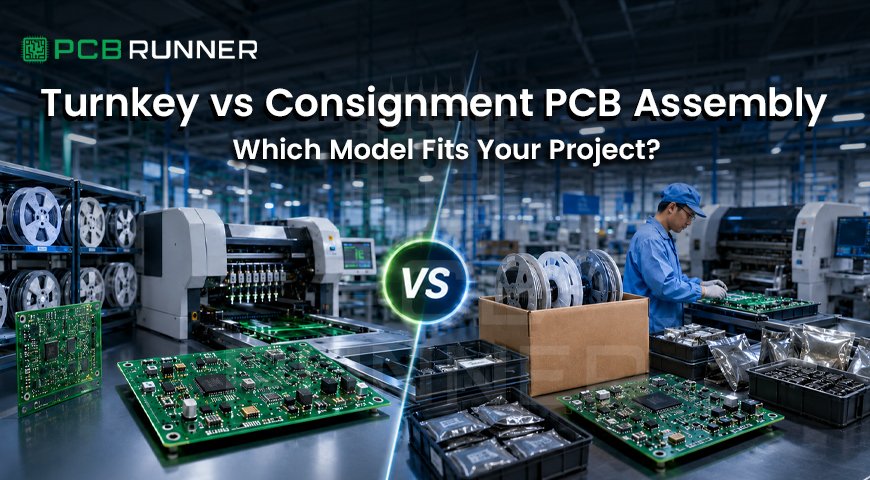
This blog walks through turnkey vs consignment PCB assembly using real project scenarios, not vendor marketing copy. Component shortages have stretched average lead times across electronics manufacturing over the past few years, and that shift alone has changed which model makes sense for most projects today.
What Is Turnkey PCB Assembly?
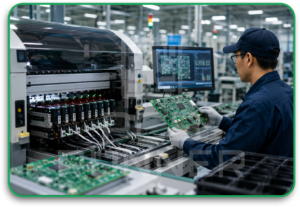
With full turnkey PCB assembly, the manufacturer buys every part, builds the board, and ships you a finished product. You send a design. They send back working hardware.
The process looks roughly like this:
- You submit Gerber files, a Bill of Materials, and placement data.
- The assembler sources every part on that list, down to the last resistor.
- Fabrication and assembly happen at one facility, so nothing gets stuck between vendors. The turnkey provider coordinates PCB fabrication, component sourcing, assembly, and testing through a single point of responsibility.
- You get tested boards, ready to use.
Turnkey PCB Assembly takes procurement off your plate entirely. PCB Runner runs this as our Full Turnkey PCB service, and component sourcing is built into the quote from the start. Hard-to-find or discontinued parts are our problem to solve, not something we hand back to you halfway through a build.
This model tends to work best for startups, small engineering teams without a buyer on staff, and anyone who’d rather deal with one vendor than coordinate three.
What Is a Consignment PCB Assembly?
Consignment assembly PCB flips that. You buy and ship every component, and the assembler charges only for labor, stencils, and the process of putting the board together.
Teams choose this route for a few practical reasons:
- They already have pricing locked in with distributors.
- Their industry demands strict component traceability, like medical or defense work.
- They have leftover stock from an earlier production run.
- Company policy requires parts from an approved vendor list only.
The tradeoff is real, and it’s worth saying plainly: you now own the procurement work, the shipping logistics, and the risk of sending a wrong reel or shorting a quantity. If one part shows up late, the whole line waits for it. Consigned PCB Assembly hands you control, and control comes with a workload attached.
Turnkey vs Consignment PCB Assembly: Side by Side
| Factor | Turnkey PCB Assembly | Consignment PCB Assembly |
| Who sources parts | Assembler | Customer |
| Procurement effort | Low | High |
| Who absorbs shortage risk | Shared with assembler | Customer |
| Best fit | No in-house buyer, tight timeline | Approved vendor lists, existing stock |
| Traceability control | Managed by assembler | Managed by customer |
| Typical lead time | Shorter, fewer handoffs | Depends on customer’s shipping |
A few manufacturers also offer partial turnkey, a middle option where the assembler sources common parts and the customer handles specialty or long-lead items. If neither extreme fits your project, ask about this during EMS partner selection. Not every shop offers it, but the ones that do can save real time.
Where Component Sourcing Actually Slows You Down
This is the part most people skip past, and it’s usually where projects actually stall.
Component sourcing PCB assembly is the biggest variable in any build schedule. A board with two hundred line items on the BOM only moves as fast as its slowest part.
Here’s a scenario that plays out often: a customer sends a design with a voltage regulator carrying a fourteen-week lead time. Under consignment, that customer has to track the part, follow up with the distributor, and hope the date doesn’t slip further. Under turnkey, the assembler catches that part during BOM review, before the order is even confirmed, and proposes an alternative with better stock availability.
One flag, caught early, can save weeks off a schedule. It’s why PCB Runner’s quoting team reviews every BOM line by line before locking in a turnkey build.
Prototypes and Small Batches: Which Model Wins?
For prototypes and low-volume runs, turnkey usually comes out ahead.
- Opening ten distributor accounts to source parts for a five-piece prototype isn’t worth the time.
- Small orders often hit distributor minimums that push per-unit cost up under consignment.
- Turnkey vendors with no MOQ, like PCB Runner, avoid that penalty entirely on small builds.
Once volumes climb into the thousands, consignment starts to make more financial sense, particularly for companies that already have negotiated distributor pricing better than what an assembler would charge.
Comparing the Real Cost
Cost comparisons between the two models get misleading fast if you only look at the invoice.
Turnkey typically includes:
- Component cost plus a sourcing markup
- Assembly labor
- Testing and inspection
Consignment typically includes:
- Assembly labor only, since parts were already purchased separately
- Possible charges for handling shortages or fixing mis-kitted reels
On paper, consignment looks like the cheaper invoice. Add up the hours your team spends sourcing parts, tracking shipments, and correcting kitting mistakes, and full turnkey often costs the same or less, especially for smaller teams without a dedicated procurement function.
Choosing an EMS Partner
Whichever model fits your project, the vendor matters more than the label on the service. Look for:
- No hidden stencil or setup fees buried in the quote.
- A DFM review included before production starts, not billed as an extra.
- Fabrication and assembly under one roof, so boards don’t sit in transit between vendors.
- Real support for component sourcing PCB assembly on obsolete or hard-to-find parts.
- A quote turnaround fast enough that you’re not waiting a week just to find out pricing.
PCB Runner builds each of these into our Full Turnkey PCB service, backed by ISO9001 certification and IPC Class 2, 3, and 3A qualification.
If your project needs both bare board fabrication and full assembly, our assembly capabilities page covers what we handle in-house, from SMT down to 0201 passives.
Ready to Move Your Project Forward?
Not sure which model your board actually needs? Send your BOM and Gerber files to PCB Runner, and our team will tell you honestly whether turnkey or consignment fits your timeline better. Most standard turnkey quotes go out within 16 to 18 hours. Get a Free Quote from PCB Runner
FAQs
Q. Can I switch from consignment to turnkey partway through a project?
Yes. Most assemblers can shift the sourcing model between production runs. If a consignment build keeps hitting part shortages, ask about moving the next batch to full turnkey instead of restructuring the whole order.
Q. Is turnkey PCB assembly more expensive than consignment?
Not always. Turnkey carries a component markup, but it removes procurement labor and shipping coordination on your end. For low to mid volumes, the total cost often lands close to consignment once your team’s time is factored in.
Q. What happens if a part goes obsolete mid-build?
Under full turnkey PCB assembly, the assembler usually catches this during BOM review and suggests an approved substitute before production starts. Under consignment, sorting that out falls on the customer. may propose an alternative component for customer engineering approval.
Q. Does turnkey PCB assembly require a minimum order quantity?
Not with every provider. PCB Runner runs turnkey builds with no MOQ, which works for a single prototype and a full production order alike.
Q. Which PCB assembly service model fits regulated industries like medical or aerospace?
Consignment gives you direct control over sourcing records, which matters when traceability rules are strict. For most commercial and industrial products, full turnkey is faster and carries less risk without that added paperwork.