Objective
This blog explains the most common PCB sourcing mistakes that slow projects down, increase cost, and create quality problems. It is written for buyers, engineers, and operations teams who need better results from PCB suppliers without relying on guesswork. The goal is to show how to source printed circuit boards more carefully by checking supplier fit, standards, communication, and assembly needs before an order is placed.
What PCB Sourcing Means
PCB sourcing is the process of finding the right supplier for a board and making sure that supplier can actually build the job the right way. It includes much more than asking for a quote.
A good sourcing process checks technical capability, materials, lead time, quality systems, documentation, inspection standards, and assembly fit before production starts. It also looks at communication, revision control, and supply chain risk.
In simple terms, PCB sourcing is not just about buying a board. It is about making sure the board can be built, checked, assembled, and delivered without creating avoidable problems later.
Key Takeaways
Good PCB sourcing is not only about price or lead time. It is about fit, control, and repeatable quality.
Many sourcing failures start before production, when buyers send incomplete files or do not define the real product need clearly enough.
Standards matter because they help teams define what acceptable quality looks like before the build begins.
Assembly matters too. A board that fabricates well can still create problems later if sourcing decisions do not support soldering, handling, testing, or final build needs.
Most sourcing mistakes can be reduced with a better release package, better supplier questions, and a more disciplined review process.

Quick Summary
Most PCB sourcing problems are not caused by one dramatic mistake. They usually come from small gaps that were missed early. A low quote gets approved too fast. Files are incomplete. The board type does not match the supplier’s real process strengths. Assembly needs are treated as an afterthought. Communication stays loose until the job starts slipping.
The fix is not complicated, but it does require structure. Define the board clearly. Match the job to the right supplier. Check standards. Review assembly fit. Control part risk. Keep communication clean. When those steps happen early, sourcing becomes far more stable.
Why PCB Sourcing Fails More Often Than It Should
A lot of PCB sourcing problems do not begin on the factory floor. They begin much earlier.
A buyer compares quotes. A supplier offers a fast lead time. Files are sent. Then the real trouble starts. The stackup is unclear. The material is not available. The surface finish does not fit the assembly plan. A board passes fabrication but causes soldering problems later. Or the supplier builds exactly what was sent, but the result still does not match the real product need.
This is why PCB sourcing needs more structure than many teams give it. Problems that look like manufacturing failures are often sourcing failures that started during quote review, supplier selection, or documentation release.
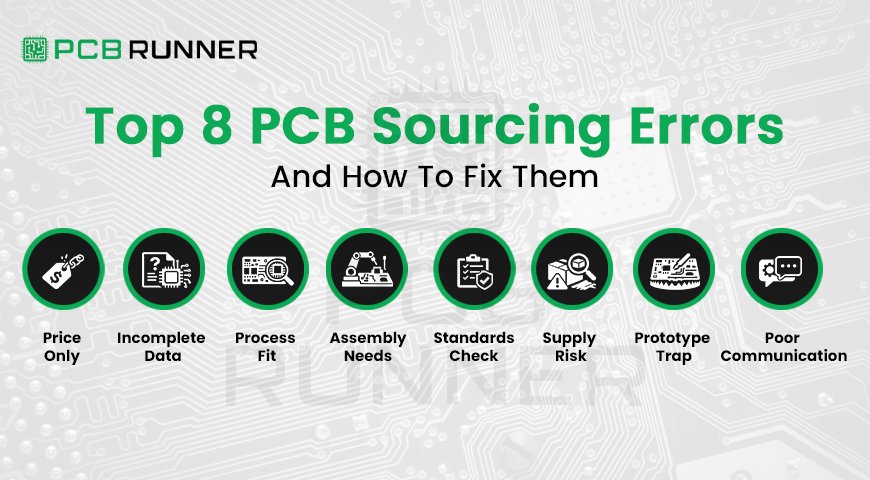
Error 1: Choosing PCB Suppliers On Price Alone
This is one of the most common sourcing mistakes.
A low quote can look attractive at the start, but cheap sourcing often becomes expensive later. If the boards arrive late, fail inspection, or create assembly rework, the original savings disappear very quickly.
When comparing PCB suppliers, teams should look beyond price. They should check actual process capability, quality control, experience with the board type, testing methods, revision handling, communication speed, and readiness for assembly support.
A sourcing decision should be based on total fit, not just initial cost. A cheap supplier that cannot control the process is usually not a good value.
How To Fix It
Build a comparison sheet that looks at the full picture. Compare suppliers on price, lead time, standards support, technical fit, testing, assembly readiness, and communication quality.
That creates a better sourcing decision because it measures real value instead of only the number on the quote.
Error 2: Sending Incomplete Data To The PCB Manufacturer
A supplier cannot build the right board from incomplete information.
This mistake happens when teams send Gerbers and assume that is enough. In reality, a strong PCB manufacturer also needs the full set of details that explains how the board should be built, checked, and accepted.
Missing information often includes stackup details, copper weight, material callouts, surface finish, impedance targets, drill data, fabrication notes, assembly drawings, and test requirements.
When those details are missing, the supplier has to guess, pause the job, or ask questions late. All three outcomes waste time and increase risk.
How To Fix It
Release a complete manufacturing package every time. That package should include fabrication files, assembly files, notes, material expectations, and any acceptance requirements that apply.
Do not leave the supplier to fill in the blanks. That is one of the fastest ways to create delays and confusion.
PCB Sourcing Process
A simple PCB sourcing process usually follows one clear path:
define the board requirement, prepare complete fabrication and assembly files, shortlist suppliers based on technical fit, review standards and quality controls, confirm lead time and material availability, check assembly compatibility, review supply chain risk, and release the order only after open questions are resolved
This process is simple on purpose. It gives teams one clear path to follow before they commit to a supplier. When the sourcing flow is rushed or skipped, the same mistakes tend to appear again and again.
Error 3: Ignoring PCB Technologies And Process Fit
Not every supplier is right for every board.
Some PCB suppliers are strong in simple two-layer boards. Others are better suited for High Density Interconnect PCB, controlled impedance, flex, heavy copper, or complex multilayer designs. Trouble starts when buyers assume all suppliers are equally capable across all board types.
That assumption creates risk in fine-line boards, blind and buried via designs, high-speed layouts, thermal-heavy boards, flex circuits, and safety-critical products.
A supplier may be able to quote the job without being able to control it well. That is the real problem. A quote does not prove process fit.
How To Fix It
Ask direct questions before the order is released.
What board types does the supplier build most often and actual process limits? What testing is used for that board type? Which materials are stocked or qualified regularly? Which design features create risk for that supplier?
Those questions help teams find real process fit instead of relying on sales language.
Error 4: Overlooking PCB Manufacturing And Assembly Needs
A board that fabricates well can still fail in assembly.
This happens when sourcing is treated as a bare-board purchase only, even though the real product depends on fabrication and assembly working together. A board can meet fabrication requirements and still create soldering, handling, or warpage issues later if assembly needs were ignored during sourcing.
Typical disconnects include a surface finish that does not match the assembly timeline, material choices that struggle during soldering, poor panelization, weak mask clearances, or board structures that create handling problems.
How To Fix It
Ask pcb manufacturing and assembly questions during sourcing, not after fabrication.
Will the board move directly into assembly? Which surface finish best supports that assembly flow? Are there thermal limits to consider? Does the panel design support handling, test, and soldering? Can the supplier provide feedback that connects bare-board decisions to assembly performance?
That is how teams reduce problems that appear only after the boards arrive.
Error 5: Not Verifying PCB Quality Standards
Many buyers ask a supplier if they follow IPC and then stop there. That is not enough.
It is more important to understand which standards matter for the specific board and how the supplier uses them in real inspection and acceptance decisions. A supplier may say yes to standards support, but that answer means very little without more detail.
Teams need to know which standards apply, which revision level is being used, how inspections are performed, and how gray areas are handled when something is not fully clear.
How To Fix It
Ask better questions.
Which standards apply to this board? Which revision levels are active in the process? How does the supplier inspect against those standards? What happens when a board sits near the acceptance boundary? Can class-based acceptance be supported when needed?
That gives buyers a much clearer view of how quality is controlled.
Error 6: Failing To Check The Supply Chain And Part Risk
This mistake matters even more when sourcing includes parts or full builds.
A board can be built well and still fail as a product if the parts supply chain is weak. Unknown substitutions, poor traceability, weak distributor control, and missing counterfeit avoidance steps all create risk.
This issue often gets ignored when a program is moving fast. Teams focus on lead time and assume part sourcing will work itself out. That assumption can become very expensive later.
How To Fix It
If the supplier is handling parts, ask how those parts are sourced and controlled.
Do they buy only from approved sources? How are substitutions handled? What traceability is kept? Is there a counterfeit avoidance process? Who approves alternates?
These are not excessive questions. They are basic supply chain controls.
Error 7: Treating Prototype Success As Full Production Proof
A prototype run can go smoothly and still tell you very little about production readiness.
Prototype builds are often handled with more attention, lower volume, and tighter manual control. Materials may be managed more closely. Inspection may be more detailed. Engineering attention is usually higher too.
Then the project scales up and new problems appear. Yield drops. Material continuity changes. Process variation grows. Documentation gaps become more costly. Packaging and handling problems finally show up.
Prototype success is useful, but it is not final proof that the job is ready for stable production.
How To Fix It
Before scaling, review production assumptions clearly. Check yield expectations, material continuity, inspection planning, panel strategy, test coverage, assembly flow, and packaging for shipment and storage.
That extra review helps separate a successful first build from a truly scalable program.
Error 8: Poor Communication During PCB Board Production
Even a strong supplier can struggle when communication is weak.
Problems appear when revision changes are unclear, technical questions sit unanswered, notes are scattered across emails, build updates are not documented, or internal teams are not aligned on what has actually been approved.
Poor communication creates preventable delay. It also creates rework because people start working from different assumptions.
How To Fix It
Set up a simple communication system before the build starts.
Use one released revision set. Assign one owner for technical questions. Keep one written record of changes. Use one approval path for deviations. Hold one pre-build review before release.
That level of control does not make the process slower. It usually prevents the kind of confusion that causes the biggest delays later.
PCB Sourcing Risk Matrix
| Risk Area | Common Problem | Likely Impact | Risk Level | Best Fix |
| Supplier Selection | Choosing by price alone | Poor quality, delays, rework | High | Compare suppliers by capability, quality, and communication |
| Technical Data | Incomplete files or notes | Wrong build, quote delays, confusion | High | Release a full manufacturing package |
| Process Fit | Wrong supplier for the board type | Yield loss, reliability issues | High | Match board needs to actual supplier capability |
| Assembly Fit | Bare board sourced without assembly review | Soldering problems, warpage, rework | High | Review fabrication and assembly together |
| Standards Control | Standards not checked clearly | Quality disputes, inconsistent acceptance | Medium To High | Confirm standards, revision levels, and inspection method |
| Supply Chain | Weak traceability or uncontrolled substitutes | Counterfeit and reliability risk | High | Use approved sources and clear traceability rules |
| Scale-Up Planning | Prototype treated as production proof | Volume issues, yield changes | Medium To High | Review production readiness before scaling |
| Communication | Loose revision and change control | Build errors, delays, rework | High | Use one revision system and one approval path |
This table gives a simple view of where sourcing risk usually appears and how to reduce it before it becomes expensive. The pattern is clear. Most high-risk problems start early, long before the factory begins the build.
Conclusion
The biggest PCB sourcing mistakes are usually not dramatic. They are small gaps in judgment that grow into larger problems later. Choosing PCB suppliers by price alone, sending incomplete files, ignoring process fit, overlooking assembly needs, skipping standards review, and allowing weak communication can all damage cost, schedule, and quality.
The fix is not complicated, but it does require discipline. Define the board clearly. Match the job to the right supplier. Check standards. Review supply chain risk. Think about assembly early. Control communication from the start.
PCB sourcing works best when it is treated as more than a purchasing task. It is part engineering decision, part quality decision, and part supply chain decision. When that mindset improves, the results usually improve too.
FAQs
What Is The Most Common PCB Sourcing Mistake?
One of the most common mistakes is choosing PCB suppliers on price alone. A low quote may look attractive early, but it does not guarantee process control, communication quality, or reliable long-term results.
Why Do Incomplete Files Cause PCB Sourcing Delays?
Because the supplier cannot build or inspect the board correctly without full information. Missing stackup details, materials, finish notes, drill data, or test requirements force the supplier to guess or stop and ask questions later.
Why Is Process Fit Important In PCB Sourcing?
Because not every supplier is suited for every board type. A supplier may be fine for simple boards but struggle with HDI, flex, heavy copper, or high-speed layouts. Good sourcing depends on matching the board to real process capability.
Why Does Assembly Matter When Sourcing Printed Circuit Boards?
Because a board can pass fabrication and still create problems during soldering or final build. Surface finish, warpage, panelization, and material behavior all affect assembly performance.
How Can Buyers Reduce Part And Supply Chain Risk?
If the supplier also handles parts, buyers should ask about approved sources, substitutions, traceability, and counterfeit avoidance controls. These checks help reduce reliability and authenticity risk.
Why Is Prototype Success Not Enough For Production?
Because prototype runs often involve lower volume, closer manual control, and more engineering attention. Production introduces more variation, more material pressure, and more process risk. A successful prototype is helpful, but it does not prove full production readiness.