Objective
This blog is for engineers and product teams who’ve built a working prototype and are about to scale it into volume production. It walks through why boards that work perfectly at five units sometimes fail at five thousand, and how to catch those problems before they turn into an expensive redesign.
Key Takeaways
- Moving from PCB prototype to production fails most often because of decisions made during prototyping that never get revisited before scale-up.
- A design freeze should happen only after DFM, DFA, and sourcing checks are complete, not before.
- NPI PCB manufacturing processes exist specifically to catch these gaps early, through structured reviews rather than guesswork.
- Component substitutions that worked fine on five prototype boards can quietly break yield at ten thousand units.
- A production readiness review costs a few days upfront. A redesign after tooling and inventory is committed costs weeks, sometimes months.
Five prototype boards worked fine on the bench. Then the production order for eight thousand units came back with a 12% failure rate at the final test, and nobody could say why, because the design hadn’t changed.
That gap between prototype and production trips up more hardware teams than any single design flaw does. The board isn’t broken. The process between “it works” and “it scales” is where things quietly go wrong.
This is the real challenge of taking a PCB prototype to production: five boards hand-soldered on a bench and eight thousand boards run through automated assembly are not the same manufacturing problem, even when the schematic hasn’t moved an inch. According to IPC’s own guidance on new product introduction, most production defects trace back to decisions made during design, not during the build itself. Many production issues can be traced back to DFM, DFA, component sourcing, and testability decisions that were not fully resolved before volume production.
Why Prototypes Break During Scale-Up
A prototype answers one question: does the circuit work? Production has to answer several more.
Here’s what changes the moment volume enters the picture:
- Manual assembly steps that worked fine at five units become bottlenecks or error sources at scale.
- Hand-picked components from a distributor’s shelf get swapped for reeled parts sourced months later, sometimes from a different lot.
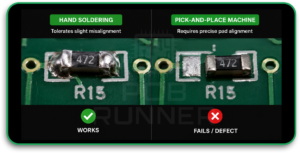
- Tight tolerances that a skilled technician could work around by hand don’t survive automated pick-and-place.
- Thermal and mechanical stress that never showed up in a bench test appears once boards go into an enclosure or a reflow oven at scale.
None of these are design failures in the strict sense. They’re gaps between how a board was built once and how it needs to be built ten thousand times.
What Changes Between Prototype and Production
Short answer: volume changes tolerances, sourcing, and process, even when the schematic stays exactly the same.
A few concrete examples:
- Component footprints. A 0402 resistor placed by hand tolerates a slightly off pad. A pick-and-place machine running at speed does not.
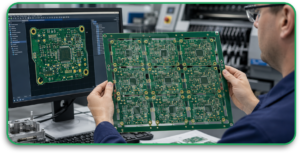
- Panelization. Boards designed as single units often need rework for panelization once they move into prototype to volume production PCB runs, and that rework touches routing, tabs, and fiducials.
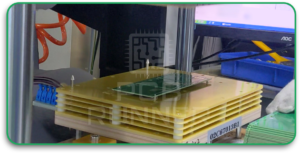
- Test coverage. A prototype gets checked visually. Production needs In-Circuit Test (ICT) or functional test points designed into the board from the start, or testing becomes slow and unreliable.
Case in point: a customer building an industrial sensor board had zero prototype failures across ten units. At two thousand units, AOI started flagging solder bridging on a fine-pitch connector, because the prototype run had used a hand-soldered assembler which compensated for a tight pad spacing that the design file never actually corrected. The fix took two days once caught early. Caught after full production, it would have meant reworking the panel design and requalifying the stencil.
What Is a Design Freeze, and Why Timing Matters
A design freeze means the design stops changing, and everyone downstream, fabrication, assembly, sourcing, works from that exact file.
The mistake most teams make is freezing too early, before checking whether the design can actually be manufactured at volume. A freeze isn’t a milestone you hit because a deadline arrived. It’s a decision you make once specific things are confirmed:
- DFM (Design for Manufacturability) review is complete, and flagged issues are resolved.
- DFA (Design for Assembly) checks confirm the board can be built on production equipment, not just by hand.
- Every component on the BOM has confirmed availability at the volume you need.
- Test points and fixturing are designed in, not added afterward.
Freeze the design before these are done, and you’re locking in problems instead of locking in a working board.
The Role of NPI in Catching Problems Early
NPI PCB manufacturing, short for New Product Introduction, is the structured process that sits between “the prototype works” and “we’re placing a production order.”
It typically includes:
- A formal DFM/DFA review against the actual manufacturing line, not a generic checklist.
- A pilot run, usually 50 to 200 units, built on production-representative tooling.
- Component sourcing verification, checking not just price but real lead times and lot consistency.
- A documented sign-off before the order scales further.
PCB Runner runs every quote through a free DFM review before fabrication starts, precisely because catching a footprint or clearance issue on paper costs nothing compared to catching it on a finished panel.
Common Redesign Triggers (and How to Avoid Them)
Most redesigns trace back to a short list of repeat offenders.
- Untested component substitutions
A part goes end-of-life, and someone swaps in a “compatible” replacement without rechecking footprint, tolerance, or thermal rating. Fix: require a full requalification for any substitution, not just a datasheet comparison. - Skipped stress testing
Bench testing at room temperature doesn’t reveal what happens at the operating temperature range the product will actually see. Fix: run thermal cycling before scale-up, not after field returns start coming in. - Ignoring panelization early
Boards designed without panelization in mind often need routing or tab rework once volume assembly starts. Fix: design with panelization in mind from the first layout pass, even for a prototype. - No test points in the original layout
Retrofitting test access after the layout is locked usually means redesigning traces. Fix: add test points during initial design, even if the prototype run doesn’t use them yet.
What a Production Readiness Review Actually Covers
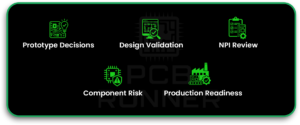
A production readiness review is the final checkpoint before committing to a full-volume order. It typically confirms:
| Area | What Gets Checked |
| Design | DFM/DFA sign-off, no open engineering change requests |
| Sourcing | Every BOM line has confirmed stock at required volume |
| Process | Assembly line has run a pilot build with acceptable yield |
| Testing | Test coverage and fixturing are in place and validated |
| Documentation | Fabrication and assembly drawings match the frozen design |
Skip any one of these, and you’re placing a production order on assumptions instead of confirmed data.
If you’re early in this process, our quick turn PCB prototyping service is built specifically to support the iteration cycle before a freeze, so design issues surface while changes are still cheap. For teams building their first product from the ground up, our practical guide to prototyping for new hardware ventures covers this in more depth.
What This Costs You If You Skip It
A DFM review or a pilot run adds a few days to your schedule. Skipping it and hitting a redesign after production tooling is committed costs considerably more; industry estimates commonly cite redesign costs rising tenfold or more once a product reaches full production compared to catching the same issue during design.
That’s not a scary number. It’s the practical reality of reworking a stencil, requalifying a panel, and re-running a pilot batch after the first production order has already shipped defective units.
Ready to Move From ProtSotype to Production Without the Guesswork?
If you’re planning a scale-up and want a second set of eyes on your design before committing to a production run, send your files to PCB Runner. Every quote includes a free DFM review, so problems get flagged before they become a redesign.
Start Your Free DFM Review with PCB Runner
FAQs
Q. How many prototype units should I build before scaling to production?
There’s no fixed number, but a pilot run of 50 to 200 units on production-representative tooling is standard practice. It’s large enough to expose assembly-line issues that five hand-built boards won’t reveal, without committing to a full production order.
Q. What’s the difference between a prototype PCB and a production PCB?
The schematic can be identical. What changes is manufacturability: footprints suited to automated placement, confirmed component sourcing at volume, and test points designed in from the start. A board built for one-off prototyping doesn’t automatically translate to a board built for ten thousand units.
Q. When should I freeze my PCB design?
Only after DFM and DFA reviews are complete, component sourcing is confirmed at your target volume, and test coverage is designed in. Freezing before these checks locks in problems instead of a working design.
Q. Why did my board pass prototype testing but fail at production volume?
Usually because prototype builds involve manual compensation, a technician hand-placing a tight-tolerance part, for example, that automated production equipment can’t replicate. A DFM review before scale-up catches most of these gaps.
Q. Does a DFM review cost extra?
Not with every manufacturer. PCB Runner includes DFM review as a standard part of every quote, since catching an issue on paper is far cheaper than catching it on a finished production panel.