Objective
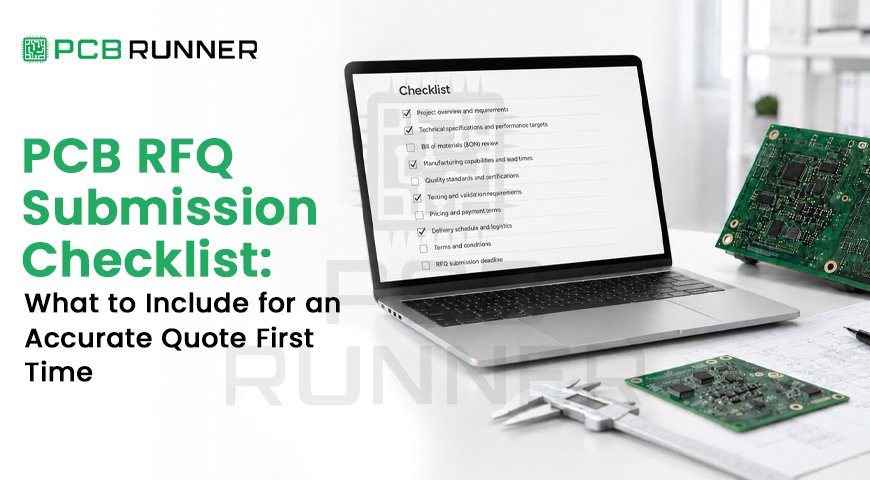
Give engineers and buyers a practical, no-fluff checklist for submitting a PCB RFQ that gets an accurate quote on the first pass, without three rounds of clarification emails.
Key Takeaways
- A PCB RFQ checklist should cover four things: design files, board specs, quantity and timeline, and quality requirements. Missing any one of these items creates the biggest risk of inaccurate or delayed quotes.
- Gerber files alone are not enough for an accurate PCB quote request. You also need a complete BOM, board thickness, layer count, and surface finish.
- A vague BOM line item (“resistor, 10k”) forces a supplier to guess. A complete one, with MPN, package, and designator, gets priced correctly the first time.
- Fabrication-only RFQs and full assembly RFQs need different information. Sending assembly-level detail for a bare-board order, or the reverse, slows everything down.
- Free DFM feedback before production catches design issues that would otherwise show up as a rejected quote or a manufacturability delay later.
Most engineers have submitted an RFQ, waited two days, and received a quote with three assumptions attached, none of which matched their actual requirements.
Incomplete manufacturing RFQs typically add three to five business days to the quoting cycle, just from back-and-forth clarification emails. A complete PCB RFQ checklist removes that back-and-forth entirely, because the supplier has everything needed to price the job once, correctly.
This guide breaks down exactly what to include, why each item matters, and where most RFQs go wrong. We wrote this guide from the manufacturing side, so you’ll see the same fields our quoting team requests when a submission lacks essential information.
What Should Every PCB RFQ Checklist Include?
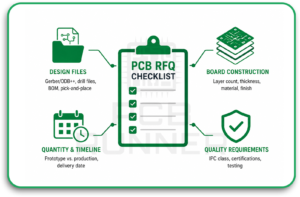
Every accurate PCB RFQ checklist needs four categories covered: design files, board construction specs, quantity and timeline, and quality requirements. Leave one out and the quote becomes an estimate, not a firm price.
Here’s the breakdown:
| Category | What It Covers | Why It Matters |
| Design files | Gerber/ODB++, drill files, BOM, pick-and-place | Defines exactly what gets built |
| Board construction | Layer count, thickness, material, finish | Drives fabrication cost and process |
| Quantity and timeline | Prototype vs. production, delivery date | Sets pricing tier and scheduling |
| Quality requirements | IPC class, certifications, testing | Determines acceptance criteria |
A short summary at the top of your RFQ, listing quantity, target delivery date, and a one-line note on the application (consumer, industrial, medical), helps a supplier route the job to the right process immediately instead of reading through files to work it out.
Which Files Do You Actually Need for an Accurate PCB Quote Request?
You need Gerber files for quote accuracy, plus a complete BOM, drill file, and pick-and-place data if the board is going to be assembled. Gerbers alone tell a fabricator what to make, not what it costs to build correctly.
Break it down by scope:
For a bare-board fabrication quote:
- Gerber files (all layers: copper, solder mask, silkscreen, paste)
- NC drill file
- Fabrication drawing with stack-up, material, and tolerances
- Board outline and panelization notes, if applicable
For a full assembly quote, add:
- Bill of Materials (BOM)
- Centroid or pick-and-place file
- Assembly drawing showing polarity, orientation, and any manual operations
- Test or programming files, if the board needs functional test or firmware loading
ODB++ or IPC-2581 formats carry more construction intelligence than standard Gerbers and cut the chance of a misread layer, but standard Gerbers work fine as long as the fabrication drawing fills in the gaps.
How Do You Prepare a BOM That Doesn’t Slow Down Your Quote?
A quote-ready BOM for quote purposes needs the exact manufacturer part number, not just a value or a generic description. “10k resistor” tells a supplier nothing about package size, tolerance, or availability.
Here’s the difference in practice:
| Vague BOM Line | Quote-Ready BOM Line |
| Resistor, 10k | R1, 10kΩ ±1%, 0603, Yageo RC0603FR-0710KL |
| Cap, 0.1uF | C4, 0.1µF, 50V, X7R, 0402, Murata GRM155R71H104KE14D |
| IC, MCU | U2, STM32F103C8T6, LQFP-48, STMicroelectronics |
For every fitted item, include:
- Reference designator (R1, C4, U2)
- Manufacturer name and exact part number
- Quantity per board
- Package or footprint
- Fitted or do-not-fit status
If some parts allow substitutes, say so and name the approved alternates. Leaving “alternate OK” without limits just pushes the decision back to the supplier, and that’s exactly the kind of assumption that changes your price later.
Which PCB Manufacturing Specs Change Your Price the Most?
Layer count, board thickness, material, and surface finish drive most of the cost variation in PCB manufacturing. These four specs alone can shift a quote by a wide margin, so state them precisely rather than leaving them as “standard.”
Cover these on every RFQ:
- Layer count: 2-layer, 4-layer, 6-layer or higher
- Board thickness: standard is 1.6mm; flag anything different
- Material: standard FR-4, or a high-frequency material like Rogers for RF and 5G applications
- Copper weight: 1oz or 2oz, and whether inner and outer layers match
- Surface finish: HASL, ENIG, OSP, or immersion silver
- Impedance control: target impedance and tolerance, if the design needs it
If you’re not sure which finish or material fits your application, describe the end use (outdoor, high-frequency, high-temperature) and ask for a recommendation rather than guessing at a spec you’re not confident about.
Do You Need DFM Feedback Before You Submit?
Yes, if there’s any chance the design has a manufacturability issue, and most first-time or revised designs do. DFM feedback catches problems like insufficient trace spacing, drill sizes below capability, or component footprints that don’t match the part before you’re committed to a production run.
A DFM check typically flags:
- Trace and spacing violations against the fabricator’s capability
- Drill-to-copper clearance issues
- Silkscreen overlapping pads
- Panelization or tooling-strip conflicts
Getting this feedback before production, not after boards are already built, is the difference between a quick design tweak and a scrapped batch. PCB Runner reviews every Gerber and BOM submission for manufacturability at no charge as part of the quoting process, so issues get flagged at the RFQ stage, not discovered on the shop floor.
If your project needs a specific acceptance standard, say so on the RFQ. PCB Runner is ISO 9001 certified and builds to IPC Class 2, 3, and 3A depending on the application, so medical, aerospace, or defense-grade boards get the right inspection criteria from the start instead of a generic “standard quality” assumption.
Fabrication Only or Full Assembly: Are You Sending the Right Checklist?
These are two different jobs with two different file sets, and mixing them up is one of the most common reasons an RFQ comes back with follow-up questions. A fabrication-only order doesn’t need a BOM. An assembly order without a complete BOM can’t be quoted at all.
If you only need bare boards built, your RFQ should focus entirely on the fabrication data: Gerbers, drill files, and a fabrication drawing. If you need the board built and populated, the full checklist above (BOM, centroid file, assembly drawing) applies. State which one you need at the top of the RFQ so the right team picks it up immediately, whether that’s fabrication only, partial turnkey, or full turnkey with component sourcing included.
What Affects PCB Fabrication Quote Turnaround in the UK?
Quote turnaround depends mainly on file completeness, not on how busy the supplier is. A complete submission with all files and specs filled in typically gets priced within 24 hours; an incomplete one goes into a clarification queue first.
For a PCB fabrication quote, UK buyers should also factor in:
- Delivery destination and whether expedited shipping is needed
- Whether the order is prototype (small quantity, faster to schedule) or production volume
- Component lead times, if the order includes assembly and parts need sourcing
Prototype quantities with no minimum order requirement move fastest, since there’s no tooling or bulk material planning involved. Production orders take a little longer to quote accurately because component pricing and availability need checking first.
It helps to separate two numbers that often get blurred together: how fast you get quoted, and how fast the board actually ships. A complete RFQ can get priced within a day. Build time is a separate clock that starts once the order is placed.
Common Mistakes That Cause a Requote
| Mistake | What It Causes |
| Sending Gerbers with no fabrication drawing | Supplier has to guess stack-up and tolerances |
| Generic BOM descriptions instead of MPNs | Wrong parts priced, requote needed |
| No quantity or timeline stated | Quote can’t be scoped at all |
| Mixed file revisions | Fabrication and BOM don’t match, causing delays |
| No note on IPC class or certifications | Acceptance criteria assumed, not confirmed |
Any one of these adds a day or more to your quote. Most of them take thirty seconds to fix before you hit send.
Ready to Submit Your RFQ?
An accurate quote starts with a complete submission, not a perfect one. Send your Gerbers, BOM, and specs through PCB Runner’s request a quote page and get pricing back without the back-and-forth.
FAQs
What’s the minimum I need to send for a rough estimate?
Gerber files and a basic idea of quantity will get you a budgetary number. For a firm, accurate quote, you’ll still need the full file package and specs above.
Can I get a quote without a 2D fabrication drawing?
Yes, but expect follow-up questions on stack-up, tolerances, and finish. A drawing removes the guesswork and speeds things up considerably.
Do you offer DFM feedback before I place an order?
Yes. Every submission is reviewed for manufacturability as part of the quoting process, at no charge, so design issues get caught early, not after production starts.
Is there a minimum order quantity?
No. Prototype runs and low-volume orders are quoted the same way as production batches, with no minimum requirement.
How fast will I get my RFQ quoted?
A complete submission, files and specs both included, is typically quoted within 24 hours. Missing files or unclear specs push that into a clarification queue first, which is where most delays actually come from.
How long does the board itself take to build once I place the order?
That’s a separate number from the quote. Standard PCB fabrication runs 3-4 working days, and quick-turn assembly runs around 3 working days, depending on layer count and complexity. Ask for both numbers upfront if you’re working to a hard deadline.