Objective
Explain how SMT stencil material choice affects solder paste deposition and first-pass yield, and give buyers a practical way to match stencil type to their component pitch.
Key Takeaways
- SMT stencil material determines how cleanly solder paste releases from each aperture, which directly affects first-pass yield
- Laser-cut stainless steel handles most standard pitch designs reliably and at reasonable cost
- Nano-coated stencils improve paste release on fine-pitch components where standard stainless steel starts to struggle
- Stencil thickness needs to match your smallest component pitch, not your board’s average component size
- Getting stencil material wrong shows up as paste bridging, insufficient deposits, or inconsistent solder joints across a panel
A board comes back from paste printing with bridging between two 0.4mm pitch QFN pads. The paste volume looks right on paper, the stencil design matches the pad layout, and the printer settings are dialed in.
The stencil material itself is usually the missing variable in that troubleshooting list. Standard stainless steel that handles a 0.5mm pitch connector without issue can struggle the moment you drop to fine-pitch components, not because the aperture design is wrong, but because the material doesn’t release paste cleanly at that scale.
SMT stencil material affects how cleanly solder paste releases from each aperture, which directly impacts bridging, insufficient deposits, and first-pass yield. Standard laser-cut stainless steel works for most designs, while nano-coated stencils handle fine-pitch components down to 0201 passives and 0.25mm IC pitch more reliably.
What Is SMT Stencil Material and Why Does It Matter?
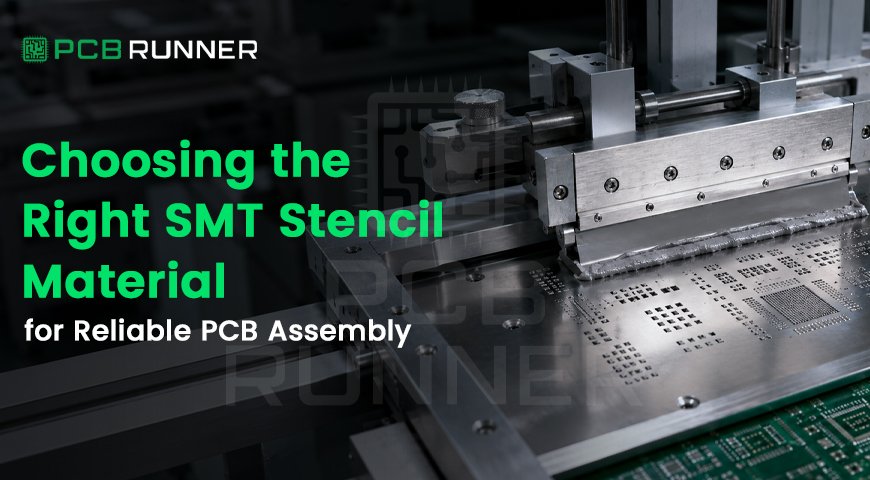
SMT stencil material is the metal sheet, laser-cut with apertures matching your pad layout, that controls how much solder paste deposits onto each pad during printing. Get the material wrong and the aperture design barely matters.
Three things the stencil material controls directly:
- Paste release — how cleanly paste separates from the aperture wall as the stencil lifts
- Aperture wall consistency — smoother walls release paste more predictably at small apertures
- Durability — how many print cycles the stencil holds up before edges wear and paste volume drifts
On a board with mixed component sizes, from through-hole connectors to fine-pitch ICs, the stencil material needs to handle the smallest, most demanding aperture on the panel, not just the average.
How Does Stencil Material Affect Paste Release?
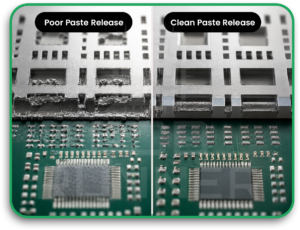
Paste release comes down to friction between the solder paste and the aperture wall as the stencil separates from the board. Rougher or less consistent walls hold onto paste, leaving deposits short or uneven.
This becomes obvious at small pitches. A standard stainless steel aperture at 0.5mm pitch releases paste without much drama. Drop to a 0201 passive or a fine-pitch IC at 0.25mm pitch, and the same material can leave paste sticking to the walls instead of depositing fully onto the pad.
That’s the practical difference between adequate and reliable stencil material: not whether it works most of the time, but whether it works consistently across every aperture on a dense board.
What Are the Main Types of PCB Stencil Material?
Most PCB stencil options fall into a small number of categories, each suited to a different pitch range and production volume.
- Laser-cut stainless steel: the standard choice for most designs, cut to precise aperture dimensions and durable enough for production runs
- Electroformed nickel: used for the tightest pitch designs where aperture wall smoothness matters more than cost, though it comes at a higher price point
- Nano-coated stencils: stainless steel treated with a coating that reduces paste adhesion to the aperture wall, improving release on fine-pitch components without the cost of electroforming
For most boards, laser-cut stainless steel handles the job reliably. It’s when pitch tightens, or the panel mixes components across a wide size range, that material choice starts to matter more than aperture design alone.
When Do You Need a Nano-Coated Stencil?
Nano-coated stencils earn their place once the design includes components where standard stainless steel starts leaving inconsistent deposits. That threshold typically shows up around fine-pitch ICs and the smallest passive packages.
Signs a design needs a nano-coated stencil rather than standard stainless steel:
- Fine-pitch ICs at 0.25mm (8 mil) pitch or tighter
- 0201 or smaller passive components, where aperture size leaves little margin for inconsistent release
- BGA, uBGA, or QFN packages with small ball or pad pitch and limited paste volume tolerance
- Mixed-technology boards combining standard components with a handful of fine-pitch parts, where one weak aperture can drag down the whole panel’s yield
PCB Runner offers nano-coated stencils specifically for boards like this, alongside standard laser-cut stainless steel for designs that don’t need it. Matching the stencil to the actual pitch on the board, not the average, is what keeps paste deposits consistent across the panel.
What Should You Check Before Choosing Stencil Material?
A few checks before finalizing stencil material, beyond just picking the option that sounds more advanced:
- Smallest component pitch on the board: this determines your minimum stencil requirement, not the board’s typical component size
- Aperture wall finish: smoother walls, whether through electroforming or nano-coating, matter more as pitch tightens
- Stencil thickness: thinner stencils suit fine-pitch components, but need to still support enough paste volume for larger components on the same board
- Print cycle durability: higher volume production runs wear stencils faster, so material choice affects how often stencils need replacing
- Compatibility with your assembly partner’s printer setup: confirm the stencil frame and tensioning match your assembler’s equipment
How Much Does Stencil Material Add to Assembly Cost?
Stencil material cost varies more by pitch requirement than by production volume. Standard laser-cut stainless steel is the lower-cost option and covers the majority of standard designs without issue.
Nano-coated and electroformed stencils cost more upfront, but that cost gets offset by fewer defects and rework on fine-pitch boards. A printed circuit board that requires several re-spins due to paste bridging on fine-pitch components often ends up costing more overall than choosing the right stencil material from the start.
PCB Runner doesn’t add stencil charges as a separate line item on assembly quotes, which removes one variable from that cost calculation. The material choice itself still depends on your board’s pitch requirements, not the invoice line.
Stencil Material Comparison at a Glance
| Stencil Type | Best Suited For | Paste Release | Relative Cost |
| Laser-cut stainless steel | Standard pitch, mixed component boards | Good for most designs | Lower |
| Nano-coated stencil | Fine-pitch ICs, 0201 passives, mixed-tech boards | Improved release at tight pitch | Moderate |
| Electroformed nickel | Ultra-fine pitch, highest precision designs | Best available at smallest apertures | Higher |
Conclusion
SMT stencil material decides whether fine-pitch components print cleanly or leave bridging and inconsistent deposits across the panel. Standard laser-cut stainless steel covers most designs, but the moment a board includes fine-pitch ICs or the smallest passive packages, stencil material choice stops being a minor detail.
If you’re working through component selection on a board that mixes standard and fine-pitch parts, our team can review your layout against our SMT Assembly capabilities, including nano-coated stencil options, at no extra stencil charge. Submit your files through our PCB Design review, or reach out to sales@pcbrunner.com to talk through your printed circuit boards requirements directly.
FAQs
Q. Can I use the same stencil for a board with both standard and fine-pitch components?
Usually yes, if the stencil material is chosen based on the smallest pitch present. A nano-coated stencil handles both standard and fine-pitch apertures reliably on the same panel.
Q. Does stencil thickness matter as much as stencil material?
Both matter, but for different reasons. Thickness controls paste volume per aperture, while material controls how cleanly that paste releases. Fine-pitch designs usually need attention to both.
Q. How do I know if paste bridging is a stencil material issue or a printer setting issue?
Check if the bridging is isolated to specific fine-pitch components while standard-pitch areas print cleanly. If so, it’s more likely material related than a printer calibration issue.
Q. Does PCB Runner charge extra for nano-coated or specialty stencils?
No. Stencil charges aren’t added as a separate cost on PCB Runner assembly quotes, standard or nano-coated.
Q. What pitch range actually needs a nano-coated stencil instead of standard stainless steel?
Generally, once a design includes 0201 passives or ICs at 0.25mm (8 mil) pitch or tighter, nano-coated stencils start showing a measurable improvement in paste release consistency.