Objective
To explain what affects quick-turn PCB prototyping timelines and how businesses can avoid common delays to get prototypes faster.
Key Takeaways
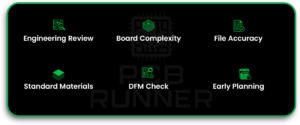
- Turnaround depends on engineering review and material availability just as much as machine speed.
- Board complexity has a direct, measurable effect on how long fabrication takes.
- Missing or inconsistent design files are the single most common cause of avoidable delay.
- Standard materials and finishes ship faster than specialty options almost every time.
- A manufacturer that runs a thorough DFM check before production catches problems before they become expensive.
- Planning ahead is still the most reliable way to get a fast prototype without sacrificing quality.
If you’ve ever waited longer than expected for a “quick turn” prototype board, you already know the label doesn’t always match reality. Quick turn PCB prototyping is only as fast as the design files, materials, and manufacturing steps behind it allow. The choices made weeks before a board hits the shop floor usually matter more than anything that happens during fabrication itself.
Missed product deadlines rarely trace back to a slow factory. Most of the time, the real cause is an incomplete file set, an overly complex layout, or a question that comes up during engineering review and sits unanswered for a day or two. If you’re working on a tight schedule, knowing what actually drives turnaround time can save you real days on a project.
What Quick Turn PCB Prototyping Actually Means
Quick turn PCB prototyping is the process of building prototype boards in the shortest realistic timeframe while still holding to production-grade quality. It exists so engineers can validate a design and move forward without sitting through a standard manufacturing queue.
Prototype runs are usually small, sometimes just a handful of boards, which gives a team room to confirm a design works before committing to a full production order. This matters across a wide range of industries: consumer electronics, medical devices, industrial automation, telecommunications, automotive systems, aerospace and defense, and IoT hardware all rely on it in one form or another.
A prototype run answers the questions that are hardest to guess at on paper. Does the circuit behave the way it was designed to? Are the footprints actually correct? Is the layout something that can be built reliably, not just simulated? Does the board hold up thermally under real load? Catching a problem at this stage costs a fraction of what it costs to fix after full production has started.
Why Speed Matters to Engineering Teams
Every revision to a board design pushes a launch date back, sometimes by days, sometimes by weeks. That’s the real reason speed matters here, not just convenience.
Teams lean on fast PCB prototyping to test new circuit designs, shorten development cycles, validate a new component or technology before betting on it, and catch issues before they reach full production. It also tends to improve how design and manufacturing teams communicate, since problems get flagged and resolved earlier in the process.
For a startup, a fast prototype can be the difference between having something to show an investor and having nothing. For an established manufacturer, it’s what keeps a production schedule from slipping.
What Happens Before Fabrication Even Starts
A common misconception is that manufacturing begins the moment an order is submitted. It doesn’t. Every board moves through several engineering and production stages first, and some of those stages carry far more weight than others when it comes to timing.
| Stage | Purpose | Impact on Turnaround |
| Order Review | Confirm files and specifications | Low |
| Engineering Review | Check manufacturability | High |
| DFM Analysis | Flag production risks | High |
| CAM Processing | Prepare manufacturing data | Medium |
| Material Allocation | Reserve laminate and copper | Medium |
| Imaging and Etching | Build the copper layers | Medium |
| Lamination | Bond multilayer boards together | High |
| Drilling and Plating | Create vias and plated holes | High |
| Surface Finish | Apply the final finish | Medium |
| Electrical Testing | Confirm connectivity | Medium |
| Final Inspection | Verify quality | Low |
| Packaging and Shipping | Get the order out the door | Low |
Engineering review is where most surprises show up. If the Gerber files contain conflicting drill data, or the fabrication notes are missing, production has to stop until someone resolves it. A single round of clarification emails can cost a day or more on an order that was supposed to be urgent. That’s exactly why a manufacturer worth working with checks everything carefully before releasing a job to the floor.
The Factors That Actually Drive Lead Time
Not every factor carries equal weight. Some sit entirely in your hands as the designer. Others come down to what the manufacturer has on the shelf and how busy their production line is that week. The list generally comes down to board complexity, layer count, material selection, copper weight, surface finish, via structure, file accuracy, manufacturing capacity, testing requirements, and shipping method.
Board Complexity
Complexity is probably the single biggest reason two prototype orders placed on the same day end up with wildly different delivery dates.
A simple board, two layers, standard FR-4, conventional through-hole vias, regular trace widths, and a straightforward outline, moves through fabrication quickly because it skips most of the extra steps a complex board requires.
A complex board asks for a lot more: high density interconnect (HDI) construction, blind or buried vias, controlled impedance, heavy copper, fine pitch BGAs, microvias, or unusually tight tolerances. Each of these adds inspection time, extra drilling passes, or additional lamination cycles. An eight layer industrial controller board might need several lamination cycles before drilling even starts, while a two layer development board skips that step entirely. The complexity doesn’t just slow fabrication either. It adds time to engineering review and final inspection too.
Layer Count
More layers mean more fabrication and inspection steps, full stop. Here’s roughly what that looks like in practice.
| PCB Type | Typical Prototype Lead Time |
| 2 Layer | 24 to 48 hours |
| 4 Layer | 2 to 3 days |
| 6 Layer | 3 to 5 days |
| 8 Layer | 5 to 7 days |
| HDI PCB | 5 to 8 days |
| Rigid-Flex PCB | 7 to 10+ days |
These numbers shift depending on the specific design and how loaded the factory is at the time, but the pattern holds. Marking an order urgent doesn’t remove a single lamination or alignment pass a six layer board actually requires.
Material Selection
Choosing an uncommon material is one of the most overlooked ways to add days to a prototype order. Most manufacturers keep standard FR-4 in stock because it covers the vast majority of projects that come through the door. Specialty laminates like Rogers materials, high frequency substrates, high temperature substrates, ceramics, or aluminum core boards often have to be sourced before production can even begin.
If the material isn’t already on the shelf, the order waits. The same logic applies to finishes. Standard options like HASL or ENIG are almost always ready faster than a specialty coating with limited demand. If your schedule is tight, sticking to standard materials wherever the design allows keeps things predictable.
Design File Accuracy
Incomplete or inconsistent manufacturing files are, honestly, the most common reason a prototype misses its target date. Even a simple two layer board can stall out if the engineering team has to stop and ask for something that should have been included from the start.
A complete file package should include Gerber files for every layer, NC drill files, a fabrication drawing, the layer stack up, the board outline, a bill of materials if assembly is required, a pick and place file for assembled boards, and any special manufacturing notes that apply.
| Issue | How It Affects Turnaround |
| Missing drill files | CAM engineers can’t generate drill programs |
| Incorrect board dimensions | Manufacturing pauses until dimensions are confirmed |
| Conflicting Gerber data | Engineering review takes longer |
| Undefined stack up | Material selection can’t start |
| Missing impedance requirements | Additional clarification is needed before fabrication |
A few extra minutes double-checking your files before submission can save several days once the job is actually in production.
What You Can Control as the Customer
A surprising amount of what slows a prototype down is entirely within your control.
Stick to standard materials where you can. Standard FR-4 and common copper weights are already stocked and ready to run. Choosing something specialized without a real technical reason behind it adds days for no benefit.
Keep the design as practical as the application allows. Every added feature, blind vias, buried vias, via in pad, extremely fine trace widths, or an unusual board outline, adds a manufacturing step somewhere down the line. Simpler designs move faster, period.
Run a full Design Rule Check before exporting anything. A proper DRC catches trace clearance violations, wrong drill sizes, missing copper connections, and unconnected nets before they turn into a phone call from the engineering team.
Lock the design before placing the order. Every revision resets part of the manufacturing process. A handful of file revisions can slow an urgent order down more than the actual fabrication ever would.
Set expectations that match reality. A 24-hour turnaround is realistic for a standard two layer board. Expecting the same from an HDI or rigid-flex design isn’t, because those manufacturing steps genuinely cannot be skipped no matter how the order is flagged.
What Depends on the Manufacturer, Not You
Not every delay comes back to the design. A manufacturer’s own capacity, inventory, and scheduling play a real role too. That includes machine availability, material inventory on hand, the depth of their engineering support, how they schedule production, their inspection process, and their shipping arrangements.
A manufacturer that keeps commonly used laminates in stock can start production immediately instead of waiting on a supplier. An experienced engineering team can often spot a design issue within hours rather than days, which matters a lot when a deadline is close.
This is where working with PCB Runner makes a difference in practice. Every order goes through a detailed engineering review before fabrication starts, which catches unexpected problems early without cutting corners on quality.
Does Paying for Expedited Service Guarantee a Faster Board?
Not exactly. Expedited service moves your order higher in the production queue, but it doesn’t skip any of the manufacturing steps a board actually needs.
A standard two layer board is easy to speed up because the process behind it is fairly simple. An eight layer board with controlled impedance still needs multiple lamination cycles, precision drilling, extra inspection passes, and full electrical testing, regardless of how urgent the order is marked. Expedited manufacturing is worth paying for when the deadline genuinely calls for it, but complexity still sets a hard floor on how fast any board can move.
Why Low Volume Prototyping Saves Time Later
Ordering a small batch of boards lets a team validate a design before committing to a full production run, which cuts both risk and cost at the same time.
Instead of building hundreds of units right away, engineers can confirm functionality, check mechanical fit, test thermal performance, verify component placement, and catch design issues while they’re still cheap to fix. Correcting a problem after building five boards is a much smaller job than correcting the same problem across a few hundred finished units. That’s a big part of why low volume PCB prototyping has become standard practice in industrial automation, medical electronics, telecommunications, and consumer product development alike.
A Realistic Look at Typical Timelines
Every project is different, but this gives a practical baseline to plan around.
| PCB Type | Typical Turnaround |
| Standard 2-layer PCB | 24 to 48 hours |
| Standard 4-layer PCB | 2 to 3 working days |
| 6-layer PCB | 3 to 5 working days |
| HDI Prototype | 5 to 8 working days |
| Rigid-Flex PCB | 7 to 10+ working days |
Projects that call for specialty materials or advanced manufacturing steps can run longer than this. If you need rapid turnaround for a UK-based project, it’s worth talking through the design with your manufacturer before you place the order so you know what’s realistically achievable.
A Quick Checklist Before You Submit Your Files
Before uploading anything, it’s worth running through this list:
- Gerber files are complete and correctly exported
- Drill files match the actual design
- Board dimensions have been double-checked
- Layer stack up is clearly defined
- Copper weight is confirmed
- Surface finish has been selected
- Manufacturing notes are included where needed
- A full Design Rule Check has been completed
- Any required documentation is uploaded
- Shipping method matches your actual timeline
This takes a few minutes and cuts down significantly on the back-and-forth that slows most orders down.
Why Work With PCB Runner
A fast board only helps if it actually works when it arrives. At PCB Runner, every prototype order goes through a manufacturability review before fabrication starts, which catches potential issues early instead of after the fact. Whether you need a simple two layer prototype or a more demanding multilayer design, the goal is a reliable result on a timeline you can actually plan around.
If you’re ready to move your next prototype forward, take a look at our Quick Turn PCB Prototyping service, or browse our related resources on PCB prototyping to see how early design decisions shape what happens in manufacturing.
Final Thoughts
Every hour counts when a new product is on a deadline. Quick turn PCB prototyping can genuinely shorten a development cycle, but the real turnaround time comes down to more than raw manufacturing speed. Design complexity, material choices, engineering review, and complete documentation all play a part in how fast a board actually ships.
The upside is that most of these factors are within your control. Submitting accurate files, sticking to standard materials where the design allows, and working with a manufacturer that takes engineering review seriously can cut real delays without giving up quality anywhere.
At PCB Runner, faster prototypes start with better planning on both ends. Our engineering-first process catches potential issues before fabrication begins, which supports reliable lead times and boards that actually hold up once they’re in your hands. If you’re ready to move your next design forward, our Quick Turn PCB Prototyping team is ready to help.
Frequently Asked Questions
What’s the fastest turnaround realistically available for a prototype?
For a standard two layer design with a complete, accurate file set, a 24 hour turnaround is often achievable. More complex boards need more time no matter how the order is flagged.
Why is my prototype taking longer than I expected?
Usually it comes down to incomplete design files, a more complex board structure than initially planned for, specialty materials, controlled impedance requirements, or a round of clarification the engineering team needed before production could start.
Does adding more layers really slow things down that much?
Yes. Each additional layer adds its own fabrication, lamination, alignment, and inspection steps, which stacks up quickly on the overall lead time.
Does a DFM review actually help with turnaround time?
It does. Catching manufacturability issues before production starts means fewer revisions later and a smoother path through fabrication overall.
Can I use a prototype run for a full production order?
Not really. Prototype services are built around validating a design in small quantities. Once testing is done, production orders typically move to a different workflow built around volume, consistency, and cost control.