PCB Material
Get PCB Materials Matched to Your Application, Not Whatever's Cheapest on the Shelf
Every board starts as a stack of laminate before it’s anything else. Get the material wrong and no amount of good layout work saves you , you’ll see it in failed reflow cycles, signal loss at frequency, or a flex circuit that cracks after a few hundred bend cycles.
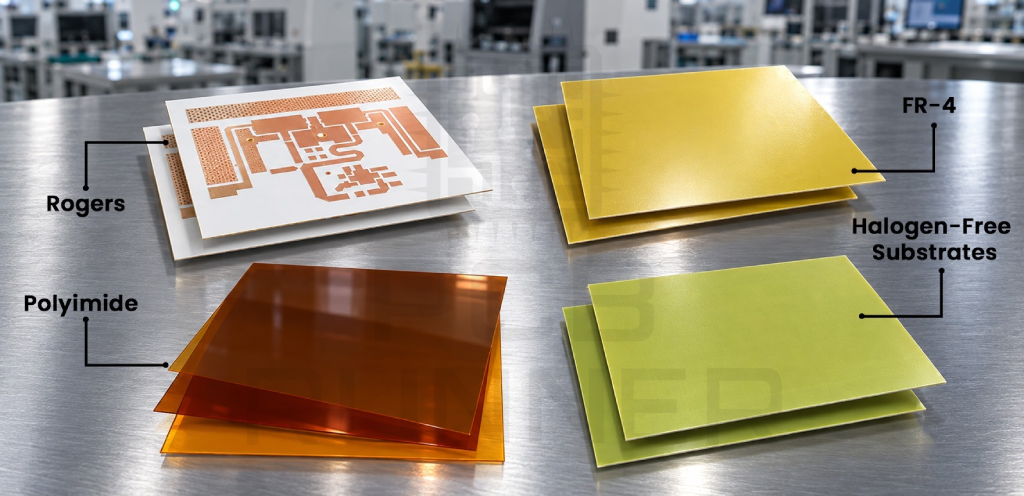
PCB Runner carries a broad range of PCB materials , standard and high-Tg FR-4, Rogers, PTFE, polyimide, and specialty HDI dielectrics , for builds across the UK and Europe. We’re not trying to sell you the most expensive laminate on the list. We’re trying to sell you the right one.
Send your Gerber files and any stack-up notes you have to sales@pcbrunner.com or call +44 203 2397011. Our engineers will look at what you’re actually trying to build and tell you, free of charge, which material makes sense.
PCB Material Properties That Affect Performance
PCB material is the substrate everything else gets built on , the laminate, the prepreg, the copper foil. It sounds like a footnote in the design process, but it’s the thing that actually decides how your board behaves once it’s populated and running.
Dielectric constant and dissipation factor determine how much signal you lose at frequency. Glass transition temperature (Tg) determines whether the board survives a 260°C lead-free reflow without delaminating. Thermal expansion, particularly on the Z-axis, determines whether plated through-holes crack after a few reflow cycles. None of this shows up on a schematic , it shows up in the field, usually at the worst time.
There isn’t one correct PCB board material. FR-4 covers most general-purpose work fine. RF and high-frequency designs need something with a tighter, more stable Dk. Anything that flexes needs polyimide, not rigid laminate pretending to be flexible. Getting this decided early, before layout is locked, is a lot cheaper than finding out the hard way.
Why Work With PCB Runner on Material Selection
We stock what most shops only quote.
Recommendations based on your application, not our margin.
High-Tg and lead-free-compatible FR-4 as a default option
Flex and rigid-flex material knowledge
A free material and stack-up review before you ever get a quote number
- We stock what most shops only quote. Standard FR-4 through Rogers and PTFE, on hand for quick turn and volume work alike , not a six-week special order.
- Recommendations based on your application, not our margin. If standard FR-4 does the job, that's what we'll tell you.
- High-Tg and lead-free-compatible FR-4 as a default option, not an upcharge tier you have to ask for.
- Real RF laminate experience. Rogers RO4000 series, RO4350, RO3010, and low-loss cyanate ester, handled by people who've built them before.
- Flex and rigid-flex material knowledge, not just rigid FR-4 experience with a flex datasheet bolted on.
- A free material and stack-up review before you ever get a quote number, so the price you see already reflects the right laminate.
Types of PCB Materials We Work With
FR-4 with Tg of 140°C
FR-4 with High Tg of 160°C
FR-4 with High Tg of 180°C
Polyimide Material
Cyanate Ester (Low Dk / Low Loss)
PTFE or Equivalents
Modified Epoxies Material
Alternative HDI Dielectrics
Halogen Free Material
Getek
Nelco 6000
BT
Taconic
Rogers RO4000 Series
Rogers RO4350
Rogers RO3010
Risholite
GIL
Matching Material to Application
| Application | Typical PCB Material |
|---|---|
| General-purpose, low-frequency designs | Standard FR-4 |
| Lead-free reflow, multilayer boards | High-Tg FR-4 (160°C–180°C) |
| RF, microwave, and high-frequency circuits | Rogers RO4000 series, RO4350, RO3010 |
| High-speed digital, low-loss signal paths | Cyanate Ester, PTFE or equivalents |
| Flex and rigid-flex assemblies | Polyimide Material |
| HDI builds with thin dielectrics | Alternative HDI Dielectrics |
| Halogen-restricted applications | Halogen Free Material |
This table is a starting point, not a final answer. A board running below 1 GHz with a tight budget rarely needs Rogers. A board pushing 28 GHz absolutely does. The frequency, thermal profile, and mechanical demands of your actual design are what settle it , worth a conversation with our engineers before you commit to a laminate on the datasheet alone.
How We Handle Material Selection
- Design Review , We look at your frequency range, layer count, thermal requirements, and whether anything in the design needs to flex.
- Material Recommendation , Our engineers suggest the printed circuit material that fits, along with a lower-cost alternative if one exists.
- Stack-Up Confirmation , Dielectric thickness, copper weight, and prepreg get locked against the chosen material before PCB fabrication starts.
- Fabrication , Lamination, drilling, and plating proceed on the confirmed material system, not a substitute.
- Testing & Verification , Electrical test, and impedance verification where relevant, confirms the material is doing what it was chosen to do.
Standards & Quality
ISO 9001:2015 certified
Material qualification against IPC-4101
RoHS-compliant
Material lot traceability
100% AOI
Impedance verification
- ISO 9001:2015 certified quality management system
- Material qualification against IPC-4101, covering dielectric performance, thermal properties, and dimensional stability
- RoHS-compliant and halogen-free material options available on request
- Material lot traceability maintained from laminate through to finished board
- 100% AOI on every panel, with electrical test (flying probe or bed-of-nails, depending on volume) on every order
- Impedance verification available where controlled impedance is specified
Where Material Choice Actually Matters
Telecommunications
Low-loss laminates like Rogers keep signal integrity intact at RF and microwave frequencies
Consumer Electronics
Standard FR-4 keeps cost sane on designs that don't need anything more
Medical Devices
High-Tg FR-4 and polyimide hold up through repeated sterilization and reflow
Automotive Electronics
High-Tg and polyimide materials survive under-hood thermal cycling
Industrial Automation
Halogen-free and standard FR-4 cover most control and sensor board needs
Aerospace & Defense
PTFE and cyanate ester support the high-frequency, high-reliability end of the spectrum
Prototype to Production: Keep the Material, Keep the Performance
Whatever material you validate at prototype stage should be the material that carries into production. This matters more than it sounds like it should , even switching within the same laminate family can shift dielectric constant and impedance enough that whatever you tested no longer applies.
We lock the material spec as part of the prototype build itself. When the design moves to volume, the same laminate, the same stack-up, and the electrical performance you already proved carry forward with it. No re-qualifying, no surprises three months into production.
Frequently Asked Questions
Standard FR-4 has a Tg around 140°C and is fine for general-purpose, lower-temperature designs. High-Tg FR-4 (160°C–180°C) is built to survive lead-free reflow at 260°C without delaminating, and it holds up better in multilayer boards that go through more than one reflow cycle.
Once you're working above roughly 2 GHz, FR-4's signal loss starts becoming a real problem. Rogers laminates , RO4000 series, RO4350, RO3010 , are built for RF and microwave work where that loss isn't acceptable.
Mostly. Its flexibility and thermal resistance make it the default for flex and rigid-flex builds. It occasionally shows up in rigid designs that need extreme thermal stability, but that's the exception, not the rule.
Yes, and that's genuinely the easiest way to do this. Send your Gerber files and any design requirements to sales@pcbrunner.com and our engineers will recommend a material free of charge.
Yes, for designs that need it for environmental or regulatory reasons.
Cyanate ester or a PTFE-equivalent low-loss laminate is usually the right call where signal integrity at speed is the priority.
Yes. Standard FR-4 is the cheapest and fastest option. Rogers, PTFE, and other specialty laminates cost more and can extend lead time depending on what's in stock at the time.
You can, and you should. Keeping it consistent means you're not re-validating electrical and thermal performance after the fact.