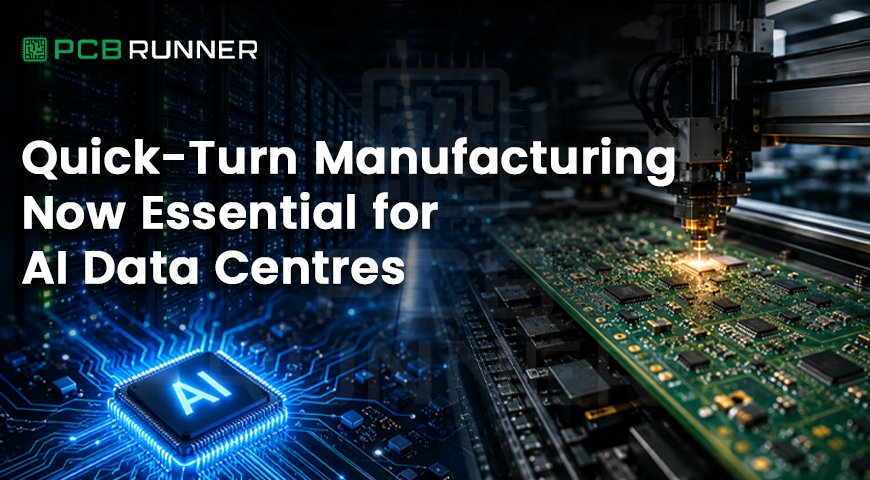
AI hardware teams cannot afford long PCB delays anymore.
AI data centres are growing fast. Every server, GPU system, switch, power module, and storage platform depends on printed circuit boards. These boards must be designed, built, tested, and revised quickly.
That is why quick-turn PCB manufacturing has become important for AI hardware development. It is no longer just a useful option for early prototypes. It is now a basic need for teams working on AI servers, GPU systems, and data centre infrastructure.
Standard PCB lead times can slow down AI programs. If every board revision takes four to six weeks, the full development cycle can stretch for months. AI hardware teams often need multiple revisions before a design is ready. They need fast boards, but they also need boards that meet strict performance and reliability requirements.
PCB Runner supports engineering teams that need Quick-Turn PCB Manufacturing for AI Data Centres and other complex hardware applications. The goal is not just speed. The goal is to help teams move faster without losing control over quality, materials, signal performance, and manufacturing accuracy.
Key Takeaways
- Quick-turn PCB manufacturing helps AI hardware teams reduce delays during design, testing, and validation.
- AI server PCBs are more complex than standard boards. They often need high-layer counts, low-loss materials, controlled impedance, strong thermal design, and reliable power delivery.
- AI hardware development often requires several rapid revisions. Waiting weeks for every PCB build can slow down the full project.
- Not every quick-turn supplier can support AI-class boards. Speed alone is not enough. The supplier must have the right materials, process control, equipment, and engineering support.
The Rapid Growth of AI Data Centres and PCB Demand
AI data centres are expanding as more companies adopt machine learning, generative AI, large language models, automation, and high-performance computing.
All of this needs physical hardware. That hardware depends on PCBs.
A single AI server can include several boards. These may include GPU boards, server motherboards, power distribution boards, networking cards, backplanes, storage interface boards, and control boards.
The demand is not only high in volume. It is also technically demanding. AI hardware needs boards that can handle speed, heat, power, dense layouts, and long operating hours.
This is why PCB manufacturing has become a critical part of AI infrastructure planning.
Why AI Infrastructure Demand Is Surging
AI has moved from research into daily business use. It now supports cloud platforms, enterprise software, image tools, video tools, search systems, robotics, security systems, and industrial automation.
These applications need more computing power. More computing power means more servers, more GPUs, more networking equipment, and more data centre hardware.
Every part of this hardware chain relies on PCBs.
As AI models become larger, the hardware becomes more complex. Boards must support faster signals, stronger power delivery, and better thermal control. This has created new pressure on PCB suppliers.
Old manufacturing timelines no longer match the pace of AI development.
Role of GPUs, Servers, and High-Speed Electronics
AI servers are built for heavy workloads.
They use high-end GPUs, CPUs, memory modules, storage devices, power systems, and high-speed networking components. These parts must work together quickly and reliably.
The PCB connects these systems. It routes signals, distributes power, supports components, and enables the system to function as a single unit.
In AI hardware, the PCB directly affects performance. Poor signal routing can create errors. Weak power delivery can affect stability. Poor thermal planning can reduce reliability.
This is why AI server PCB manufacturing needs more care than standard PCB production.
Why AI Hardware Needs Quick-Turn Differently
Quick-turn manufacturing has always helped engineers save time. But AI hardware needs quick-turn differently.
A simple PCB prototype may only need fast fabrication. AI hardware needs fast fabrication with advanced process control.
These boards often include high-speed signal paths, densely packed components, large power loads, complex stack-ups, and stringent thermal requirements. A small problem in one revision can delay the next test cycle.
AI hardware teams also test multiple design changes simultaneously. They may compare different power layouts, connector positions, signal routing options, material choices, or cooling approaches.
That means quick-turn is not only about shipping boards quickly. It is about helping engineers learn faster from real hardware.
The supplier must be ready for advanced laminates, high-layer-count builds, controlled impedance, HDI features, and clear communication with engineering teams.
AI Hardware Applications
AI hardware is used across many systems inside modern data centres.
Among the most common applications are AI server boards. These boards connect processors, GPUs, memory, storage, power systems, and high-speed interfaces. They must support heavy workloads for long periods. These boards connect processors, GPUs, memory, storage, power systems, and high-speed interfaces. They must support heavy workloads for long periods.
GPU accelerator boards are another important use. These boards support machine learning, model training, and inference workloads. They often require robust thermal design because GPUs generate significant heat during operation.
Networking equipment is also critical. AI data centres rely on fast communication between servers. Switches, routers, network interface cards, and backplanes must move large amounts of data with low delay.
Power distribution boards also play a major role. AI systems draw large amounts of power, and that power must be delivered safely and consistently.
Storage and memory interface boards are also part of the AI hardware ecosystem. As AI models become larger, fast data movement becomes even more important.
Each of these applications needs PCBs that are reliable, fast to build, and suitable for demanding operating conditions.
Why PCBs Are at the Centre of AI Hardware Development
PCBs are the foundation of AI hardware.
They connect every major component in the system. They provide power, route signals, support cooling strategies, and enable the hardware to function as a single platform.
Without the PCB, even the most advanced AI chip cannot work inside a real product.
This is why PCB design and manufacturing decisions directly affect AI hardware performance.
A delayed board can slow the entire hardware program. When a board fails, engineers must revise and rebuild. When a supplier cannot support the required specifications, the project faces serious risk.
Quick-turn PCB manufacturing helps reduce that risk when a capable partner handles it.
Importance of High-Speed Signal Transmission in AI PCBs
AI hardware depends on fast data movement.
Signals must travel between processors, GPUs, memory, storage, and networking interfaces with very little loss. As data rates increase, PCB design becomes more sensitive.
Controlled impedance is important. The stack-up must be planned carefully. Trace width, spacing, materials, vias, and copper layers all matter.
Standard PCB materials may not be enough for high-speed AI systems. Many designs require low-loss laminates to improve signal performance.
This is one reason many normal quick-turn suppliers struggle with AI hardware. They may be fast with simple boards, but they may not be ready for high-speed AI server PCB requirements.
Thermal and Power Challenges in AI Hardware
AI systems consume significant power and generate substantial heat.
High-performance GPUs and processors place heavy demands on the PCB. The board must carry current safely and help control heat across the system.
This often requires heavier copper, thermal vias, strong power planes, high-temperature materials, and careful spacing around high-power parts.
Thermal stress is not only a design issue. It is also a manufacturing issue.
If the board is not built correctly, it may fail during testing or long-term use. That is why AI server PCBs need both fast delivery and strong manufacturing discipline.
What Quick-Turn PCB Manufacturing Actually Means
Quick-turn PCB manufacturing involves producing boards in much less time than standard lead times.
For simple boards, this may mean delivery in 24 to 48 hours. For complex boards, it may mean a few business days or a shorter-than-normal production cycle.
True quick-turn manufacturing is not just a promise to rush an order. It requires a process built for speed.
A strong, quick-turn program usually includes ready material stock, fast engineering review, quick CAM processing, clear communication, dedicated production capacity, and inspection steps that do not create unnecessary delays.
For AI hardware, quick-turn must also include technical capability. The supplier must handle advanced materials, high-layer counts, tight tolerances, and controlled-impedance requirements.
Why Standard Lead Times No Longer Work for AI Projects
Standard PCB lead times can create serious problems for AI hardware teams.
Many AI hardware projects move through fast design and testing cycles. Engineers need to move quickly from design to prototype. Then they need to test, revise, and build again.
If every revision takes four to six weeks, the schedule becomes too slow.
Quick-turn manufacturing gives engineers a faster way to validate real hardware. Instead of waiting weeks to discover a problem, they can test sooner and make the next decision faster.
This is especially important because AI hardware rarely becomes production-ready in one revision.
How Quick-Turn Supports AI Server PCB Development
Quick-turn manufacturing helps AI server development in practical ways.
It shortens the time between design completion and physical testing. Engineers do not have to wait weeks to see whether a design decision works.
It also helps teams compare different design options. They may test different stack-ups, routing strategies, power delivery layouts, thermal approaches, or connector placements.
Quick-turn also supports faster pilot builds. Once the prototype is close to final, teams can move toward validation and early production more quickly.
The real benefit is better decision-making. Engineers can test real boards sooner and move to the next revision with more confidence.
Traditional Server PCB Development VS AI Hardware PCB Development
| Comparison Area | Traditional Server PCB Development | AI Hardware PCB Development |
| Design cycle | Longer and more predictable | Shorter, faster, and more iterative |
| PCB complexity | Moderate to high | Very high |
| Layer count | Often lower or moderate | Often 16 to 32 layers or more |
| Signal speed | High, but usually less demanding | Extremely high, often 56 Gbps to 112 Gbps per lane |
| Power demand | Manageable for standard server loads | Much higher due to GPUs and accelerators |
| Thermal stress | Important but more controlled | Critical due to dense, high-power components |
| Materials | Standard FR-4 may work in many cases | Low-loss, high-performance laminates are often required |
| Prototype revisions | Fewer major revisions | Multiple fast revisions are common |
| Supplier requirement | General PCB capability may be enough | Advanced quick-turn capability is needed |
| Risk of delay | Can affect launch timelines | Can delay full AI infrastructure deployment |
AI hardware PCB development puts more pressure on both the engineering team and the manufacturing partner.
The boards are more complex. The timeline is tighter. The cost of delay is higher.
Technical Requirements of High-Performance PCBs for AI Servers
AI server PCBs often need advanced manufacturing features.
They may require high-layer counts, controlled impedance, blind and buried vias, microvias, low-loss laminates, heavy copper, fine spacing, and tight drilling accuracy.
These features must be planned carefully. The PCB supplier should be involved early, especially during stack-up design.
A good supplier can confirm which materials are available, what tolerances can be maintained, and which design adjustments may improve manufacturability.
This early support helps prevent delays after files are submitted.
Advanced Materials Required for High-Speed PCBs
Standard FR-4 is often not enough for AI server boards.
High-speed AI PCBs may require low-loss laminates that help reduce signal loss. Materials such as Megtron 6, Megtron 7, and Rogers laminates are often used for demanding high-speed designs.
These materials are harder to process than standard materials. They also need proper handling during fabrication.
A quick-turn supplier must know how to work with these materials and should have access to them before production begins.
If the material is not available, the quick-turn schedule can fail before the board is even built.
Quick-Turn PCB Assembly, Speed Without Compromise
PCB assembly, the process of mounting components onto a fabricated board, is where many quick-turn programs lose time. Fabrication can be fast, but assembly lead time must also be addressed.
Effective quick-turn PCB assembly requires:
- Pre-stocked SMT components for common parts used in AI hardware designs
- Automated pick-and-place programming that is set up in parallel with board fabrication
- AOI and X-ray inspection performed in-line, not as a separate phase that adds days
- Engineering support is available immediately when assembly questions arise
The fastest programs build fabrication and assembly in parallel wherever the schedule allows, not sequentially.
Choosing the Right Quick-Turn Manufacturing Partner
Not every PCB supplier is a good fit for AI hardware.
Before choosing a partner, engineering teams should confirm the supplier’s actual capability.
They should ask about the maximum layer count, available materials, support for controlled impedance, via capability, HDI experience, inspection methods, and experience with complex boards.
They should also ask how the supplier handles file review, engineering questions, and urgent communication.
In quick-turn projects, slow communication can be just as harmful as slow production.
A good supplier will be clear about what is possible, what may cause delays, and what should be changed before production begins.
Why Many Quick-Turn Suppliers Fail
Many quick-turn suppliers fail with AI hardware because they are built for speed, not complexity.
They may handle simple FR-4 boards quickly, but AI server boards need more technical depth.
These boards may need advanced laminates, blind and buried vias, microvias, controlled impedance, tight registration, and high-layer-count stack-ups. Not every quick-turn shop has the equipment or experience to manage that level of work.
Material availability is another common issue. AI boards often need specific low-loss materials. If the supplier does not keep those materials in stock, the timeline slows down.
Communication delays also cause problems. If the supplier finds an issue but waits too long to flag it, the quick-turn advantage disappears.
Some suppliers also overpromise. They accept advanced work without checking whether their process can truly support it.
A board delivered quickly, but a board built outside tolerance is not useful. It can delay testing, waste components, and force another revision.
Common Mistakes Teams Make When Using Quick-Turn Services
Sending Files That Are Not Manufacturing-Ready
The most common cause of quick-turn delays is file problems, missing Gerber layers, incorrect drill files, undefined impedance specs, or missing fab notes. A quick-turn program that stops for file clarification loses its schedule advantage entirely. Verify your files before submitting, every time.
Choosing Speed Over Supplier Capability
A supplier who promises a five-day turnaround but has never built a 24-layer HDI board will not deliver a working AI server PCB in five days. Match the supplier’s actual capability to your technical requirements first, then optimize for speed within that qualified set of suppliers.
Not Involving the Manufacturer in Stack-Up Design
Submitting a completed 28-layer stack-up to a quick-turn fabricator without prior discussion is a recipe for delay. If the specified materials are unavailable or the impedance targets cannot be met with available prepreg combinations, the program stops. Engage your manufacturer during design, not after it.
Cost Considerations for Rapid PCB Prototyping
Rapid PCB prototyping costs more than standard production, especially for complex boards.
The price depends on layer count, material choice, turnaround time, quantity, via structure, controlled impedance needs, and assembly complexity.
For AI hardware teams, the value often comes from schedule savings.
If a quick-turn prototype saves two or three weeks, the added cost may be small compared to the cost of engineering delay or missed launch dates.
Still, teams should use quick-turn wisely. It makes the most sense when speed supports a real project milestone, urgent test cycle, or important design decision.
Future of Quick-Turn Manufacturing in AI Infrastructure
The need for fast-turn advanced PCBs will continue to grow as AI infrastructure expands.
AI systems are becoming more powerful, dense, and complex. This will increase demand for suppliers who can handle advanced boards on shorter timelines.
PCB manufacturers are responding by improving material stocking, CAM automation, inspection systems, drilling capacity, and production planning.
Quick-turn manufacturing will not be about faster builds alone. It will be about better preparation, better systems, and better support for complex engineering work.
For AI hardware teams, the right manufacturing partner will become a major part of the development process.
FAQs
What Is Quick-Turn PCB Manufacturing?
Quick-turn PCB manufacturing is a service that produces printed circuit boards faster than standard lead times. It is often used for prototypes, urgent revisions, validation builds, and short-run production. For AI hardware, it helps teams test and improve boards without waiting several weeks for each revision.
What Types of PCBs Can Be Made With Quick-Turn Services?
Fullturnkey, Fab & Assembly for Double layer, multilayer boards, controlled impedance boards, HDI boards, can be accommodated under quickturn leadtime services.
How Much Does Quick-Turn PCB Manufacturing Cost?
Quick-turn PCB manufacturing usually costs more than standard production because it requires faster processing, dedicated capacity, and tighter scheduling. The final cost depends on board complexity, material choice, layer count, quantity, turnaround time, and assembly needs.
How Can Teams Get the Most Out of Quick-Turn Programs?
Teams can achieve better results by preparing complete files, confirming material availability, involving the manufacturer early, and choosing a supplier based on capability rather than just speed. Clear communication also helps prevent delays during quick-turn production.
What Are the Biggest Challenges in AI Server PCB Manufacturing?
The biggest challenges include high-speed signal control, thermal management, power delivery, material selection, high layer counts, and tight manufacturing tolerances. AI server PCBs must deliver high performance while remaining reliable under heat, power, and continuous workload.
What Materials Are Used in AI Server PCBs?
AI server PCBs often use low-loss, high-performance laminates instead of standard FR-4. Materials such as Megtron 6, Megtron 7, and Rogers laminates are commonly used for high-speed designs. These materials help reduce signal loss and improve performance in demanding server and data centre environments.
Why Is Quick-Turn PCB Manufacturing for AI Data Centres Essential?
AI data centres require quick-turn PCB manufacturing because hardware development cycles are moving quickly. Engineers need to test prototypes, fix design issues, and validate new revisions without long delays. Waiting several weeks for each PCB revision can slow down the full server or infrastructure project.
Can Quick-Turn Manufacturing Support High-Layer-Count AI PCBs?
Yes, quick-turn manufacturing can support high-layer-count AI PCBs, but only when the supplier has the right equipment, materials, and process experience. Not every quick-turn supplier can build 16-layer, 24-layer, or 32-layer AI server boards on a fast timeline.
Conclusion
Quick-turn PCB manufacturing is now essential for AI data centre hardware.
AI development cycles are too fast for old PCB timelines. Teams need to prototype, test, revise, and validate boards quickly. At the same time, AI server PCBs are becoming more complex, with higher layer counts, faster signals, heavier power loads, and stricter material needs.
This is why speed alone is not enough.
AI hardware teams need a manufacturing partner that can move quickly while still protecting quality. The right supplier must understand advanced materials, controlled impedance, thermal design, HDI features, assembly needs, and fast communication.
PCB Runner supports engineering teams that need fast, reliable PCB manufacturing for complex hardware programs.
Fast boards are useful only when they work. A strong, quick-turn partner helps teams move faster without adding unnecessary risk.