Objective
Explain the difference between an ultra-thin rigid PCB and a high-layer-count rigid PCB in plain language. You’ll see what each type is good at, what it struggles with, and how PCB material and build choices affect real-world results. This is written to inform, not to sell.
Key Takeaways
- An ultra-thin rigid PCB is mainly about saving height and weight. It can be harder to handle during assembly.
- A high-layer-count rigid PCB is primarily about routing space and signal control. It’s used when the circuit is dense or high-speed.
- “Thinner” and “more layers” solve different problems. Trying to force one to do the other often leads to issues.
- PCB material choices matter more as boards get thinner or more complex.
- Some products avoid choosing only one by using rigid flex circuit boards (a mix of rigid and flexible sections).
Introduction
If you’re building electronics, you will run into this question sooner or later:
Do you need a thin board or one that can handle heavy routing?
That question is the heart of the ultra-thin vs. high-layer-count PCB decision.
These two board types look like they’re competing, but they’re not. They are built for different reasons. And if you pick the wrong one, you usually don’t notice right away. You see later—when the board warps, when routing becomes a mess, when signals act strangely, or when testing becomes painful.
What Is a Rigid PCB?
A rigid PCB is the standard solid board used in most products. It has:
- insulating board material (the base)
- copper layers (for signals and power)
- holes and vias (to connect layers)
- surface finish (so parts solder correctly)
Rigid boards do not bend in everyday use. If your product needs bending, that’s where flex and rigid pcb options come into play later.
What Is an Ultra-Thin Rigid PCB?
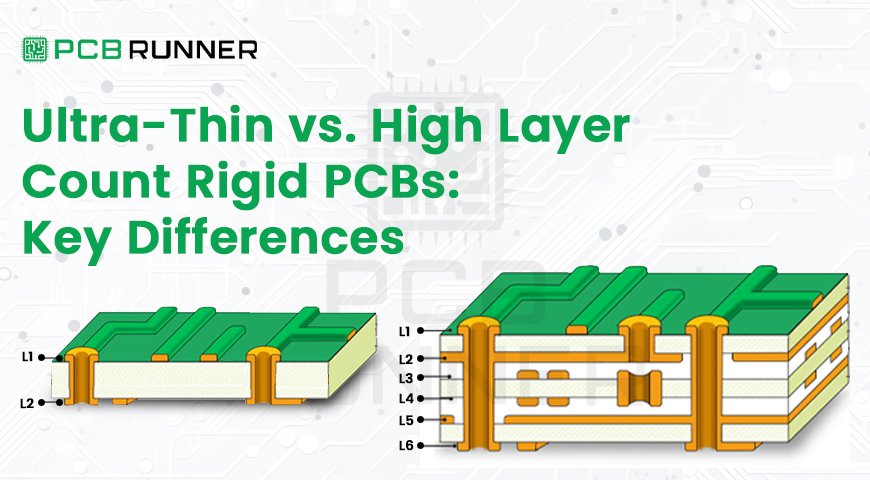
An ultra-thin rigid PCB is a rigid board built to be much thinner than typical boards. The goal is simple: reduce height.
You see these boards in products where:
- The enclosure is tight
- The product must feel slim in the hand
- The weight needs to stay low
- Internal stacking space is limited
What changes when you go ultra-thin
When a board gets thinner, a few things become more sensitive:
- It can warp more during soldering
- It can bend slightly under pressure
- It may need support during assembly and test
- connectors and screws can stress it more easily
Did you know? A board can pass bench testing and still fail later if it flexes within the enclosure whenever the product is handled.
What Is a High Layer Count Rigid PCB?
A high-layer-count rigid PCB is a rigid board with many copper layers stacked inside it. The reason is not “to be fancy.” It’s to make the circuit physically possible and electrically cleaner.
Here’s what pushes designers toward high layer count:
1) The circuit doesn’t fit on fewer layers
If the board has many parts, many nets, and tight spacing, you run out of routing room fast. Adding layers gives you more “roads” for signals to travel along.
2) You need planes for power and ground
High-speed or noise-sensitive designs often need solid ground planes. They also benefit from dedicated power planes. Planes are not just about delivering power. They also help signals return properly, which reduces noise.
3) You need controlled behaviour at higher speeds
As data rates increase, routing is no longer “just draw a line.” Trace width, spacing, and the distance to reference planes matter. Extra layers make it easier to maintain signal consistency and reduce interference.
4) You want a cleaner separation between systems
Many real products have mixed sections on one board:
- analog sensing
- switching power
- digital logic
- radios
- Putting these on a few layers can force routes to cross in evil ways. More layers can help keep sections cleaner.
What high-layer count does not guarantee
More layers do not automatically mean “better.” They can also mean:
- longer build time
- more chances for internal defects
- more difficult rework
- higher cost
So the right question is: Do you actually need the layers? If you don’t, you can pay extra and still gain nothing.
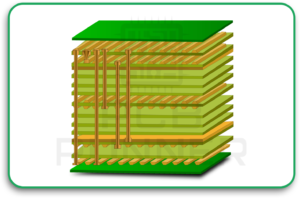
Ultra-Thin vs High Layer Count PCB: Key Differences That Actually Matter
This section is the decision-making part. Not theory. The items below are what usually appear in real builds.
1) What problem are you solving
- Ultra-thin rigid PCB solves a mechanical problem: “I don’t have height.”
- High-layer count rigid PCB solves a routing/electrical problem: “I can’t route this cleanly and control noise.”
If you treat these as the same problem, the design usually becomes difficult fast.
2) Routing freedom
- Ultra-thin boards typically have fewer layers, limiting routing options.
- High-layer count boards give more room to route without ugly compromises.
In practice, fewer layers often force:
- longer routes
- more vias
- tighter spacing
- more coupling between signals
3) Signal and noise control
- Thin boards can work fine for simpler electronics, but they give you fewer options to place ground planes where you want them.
- High-layer count boards let you keep signals close to reference planes, which helps stability at higher speeds.
If your design includes:
- fast memory buses
- high-speed interfaces
- sensitive analogue front ends
- Then the layer count becomes more important than the thickness.
4) Heat and power
This is often misunderstood.
- Thin boards do not automatically “run cooler.”
- Heat depends on copper area, layout, power components, and how the board connects to the enclosure.
High-layer count boards sometimes spread heat better because they can include more copper and planes. But they can also trap heat if the airflow is poor. It depends on the design.
5) Mechanical risk during assembly
- Thin boards are more likely to warp during reflow if the stackup and copper balance are poorly managed.
- High-layer-count boards are usually stiffer, but can still warp if the copper distribution is uneven.
6) Inspection and rework
- Ultra-thin boards can be more challenging to rework because they don’t tolerate heat or mechanical stress.
- High-layer-count boards can be more rigid to rework because traces and vias are dense, and internal layers are involved.
So “easy to fix” is not guaranteed with either choice.
7) Lead time and cost drivers
- Ultra-thin cost often comes from tighter handling requirements and yield risk.
- Materials, lamination cycles, and deeper inspection requirements drive the high-layer count cost.
Both can be expensive, but for different reasons.
PCB Material: What Changes Between Thin and Many-Layer Boards
PCB material is not a background detail. It affects:
- How stable the board stays under heat
- How signals behave
- how well the board survives long-term use
For ultra-thin rigid PCB builds
Material choices matter because thin cores are less forgiving. Slight variations can cause:
- warping
- bow and twist
- Weaker mechanical support around connectors
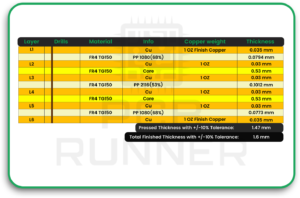
A thin board also depends more on good copper balance and proper stackup planning.
For high-layer count rigid PCB builds
With more layers, consistency becomes the primary goal. You want:
- stable dielectric thickness
- predictable electrical behaviour
- strong lamination quality between layers
High-layer boards also need clean internal registration. If alignment drifts, vias can land in the wrong spot, and reliability drops.
Where Flex and Rigid PCB Designs Fit In
Sometimes the best answer is: don’t choose only one.
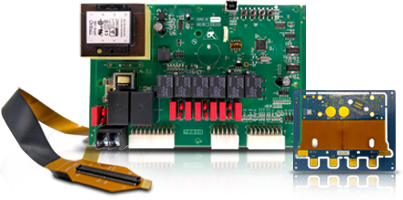
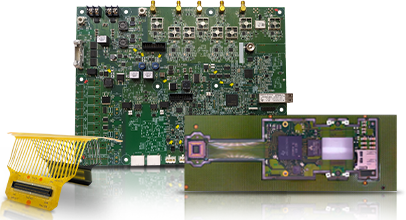
Rigid-flex circuit boards combine rigid sections (for dense circuits) with flexible sections (for folding and connecting areas). They can:
- remove connectors
- reduce wiring
- improve reliability in tight spaces
- allow cleaner packaging inside the enclosure
Rigid-flex is not always cheaper, but it can reduce assembly steps and failure points, which matters in real products.
Manufacturing and Assembly Reality Checks
Ultra-thin rigid PCB challenges
- more sensitive to handling
- can deform during reflow
- may need carriers or support tooling
- Connector insertion forces need attention
High-layer count rigid PCB challenges.
- longer fabrication cycles
- tighter process control on lamination
- Internal layer inspection becomes more important
- Complex designs need better test planning
Cost, Reliability, and Performance Trade-offs
Here’s a simple way to think about it:
- If you need thin for the enclosure, start with an ultra-thin rigid PCB, then check if routing still works.
- If you need clean routing and signal control, start with a high-layer-counta high-layer-count rigid PCB, then check whether the thickness still fits.
- If you need both, consider rigid-flex circuit boards.
No board choice fixes poor planning. But the right choice makes the rest of the project easier.
Common Mistakes People Make
- Choosing ultra-thin just because the product “should be slim,” without checking assembly and connector stress.
- Jumping to a high layer count because it sounds safer, when the design could route cleanly on fewer layers.
- Ignoring pcb material and stackup details until late.
- Not adding test points early, then struggling in production testing.
- Treating “prototype success” as proof that the design will scale.
Conclusion
The difference between ultra-thin vs high-layer count PCB is simple when you look at the real goal:
- Ultra-thin rigid PCBs are designed to fit into slim products.
- A high-layer count rigid PCB is about fitting a complex circuit and keeping it stable at higher performance levels.
Sometimes you don’t pick one. You combine approaches using rigid-flex circuit boards so the product fits and the electronics function.
At PCB runner, we use these points as a checklist before you finalise the design. It saves time, reduces costs, and prevents redesign later.
FAQs
1) Is an ultra-thin rigid PCB always the best choice for small products?
Not always. If the circuit is dense or high-speed, you may need more layers. A thin board that can’t route cleanly can create noise issues or force ugly workarounds.
2) What counts as a high-layer-count rigid PCB?
There isn’t a single fixed number, but people usually mean boards that go beyond typical 2–6-layer designs. The point is that the design needs extra internal layers for routing and planes.
3) Why do high-layer count boards help with signal quality?
Because they make it easier to place signals close to ground reference planes, control impedance, and reduce interference between traces. That matters more as speeds rise.
4) Do ultra-thin boards warp more during soldering?
Thin structures are less stiff and more sensitive to copper imbalance and thermal stress. Good stackup planning and assembly support reduce the risk.
5) How does pcb material affect these choices?
Thin boards need materials and stackups that stay stable under heat and stress. High-layer boards require consistent dielectric behaviour and high-quality lamination. In both cases, material decisions change reliability.
6) If I need both thin and complex, what should I do?
That’s a common reason people consider rigid-flex circuit boards. You can keep dense circuits on rigid sections and use flexible sections to fold or connect areas without bulky connectors.